
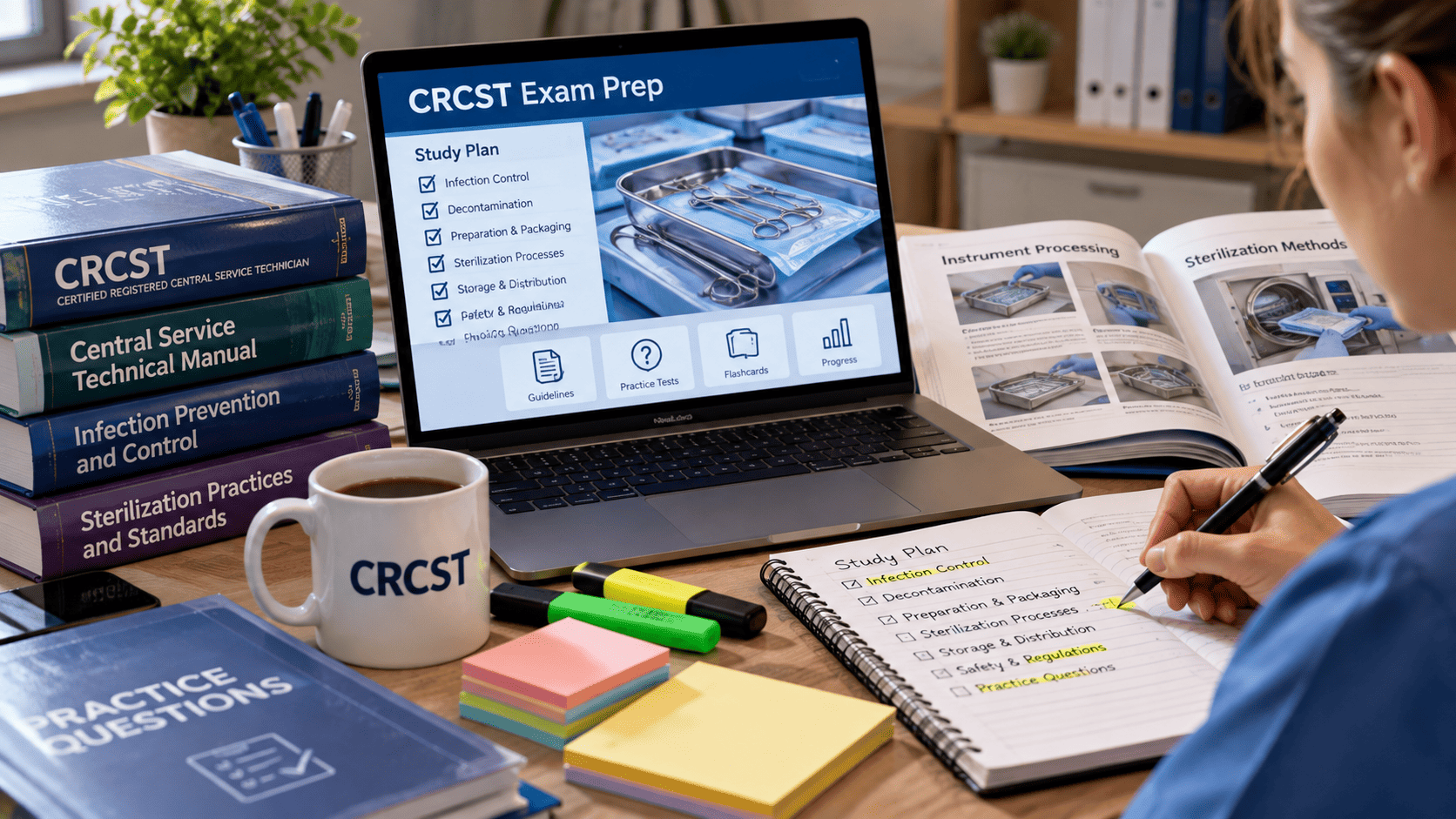
Preparing for the CRCST exam without attending a training program might sound like an attractive idea. Buy the textbooks, study at home, take practice tests, and save money on tuition.
And technically, it is possible.
The Healthcare Sterile Processing Association (HSPA) does not require candidates to complete a particular training course before applying for the CRCST exam.
But there’s a difference between being eligible to take an exam and being properly prepared to pass it.
For someone already working in sterile processing, independent study may be a practical option. For a complete beginner, the experience can be considerably more challenging.
What Makes CRCST Self-Study Difficult?
Sterile processing involves much more than memorizing the names of surgical instruments.
Students need to understand decontamination, infection prevention, sterilization methods, packaging systems, quality assurance, documentation, and the workflow of a Sterile Processing department.
These subjects are interconnected.
For example, understanding why an instrument must be cleaned before sterilization requires more than memorizing the correct sequence of steps. You need to understand the principles behind the process.
When studying independently, you are responsible for recognizing which concepts you have misunderstood.
A practice test might show that your answer is incorrect, but it may not fully explain why you made the mistake.
This becomes particularly frustrating when two answers appear similar or a technical explanation introduces terminology you have never encountered before.
Who Can Benefit From Independent CRCST Preparation?
Self-study can work well for certain candidates.
Someone already employed in a Sterile Processing department may have practical experience with instruments, sterilization equipment, documentation, and department procedures.
In that case, studying independently helps connect existing workplace knowledge with the material covered by the CRCST examination.
It may also suit people who have strong study habits and are comfortable learning technical subjects without regular instructor support.
Beginners face a different situation.
They must learn unfamiliar terminology, understand new processes, organize their own study schedule, and determine whether they are making meaningful progress.
That is why the learning format deserves as much attention as the study materials themselves.
What Changes When You Learn With an Instructor?
The most important difference is feedback.
Imagine studying sterilization monitoring and encountering a concept you cannot understand.
With self-study, you may need to search through several chapters, find another video, or look for an explanation online.
During a live class, you can ask the instructor to clarify the concept immediately.
This does not guarantee a higher examination score, but it creates an opportunity to correct misunderstandings before they affect your understanding of later material.
Live instruction also provides structure.
Instead of deciding what to study every day, students follow a curriculum, attend scheduled lessons, and progress through subjects in an organized sequence.
For people balancing employment, family responsibilities, and education, having a regular class schedule can make it easier to maintain consistent study habits.

Are Live Online Classes Different From Recorded Courses?
Yes. The word online describes how education is delivered, not necessarily how students are taught.
Some programs consist primarily of prerecorded videos and independent assignments. Others provide live instruction through platforms such as Zoom.
The second format allows students to interact with an instructor and ask questions during the lesson.
A detailed comparison of these approaches is available in Sterile Processing Self-Study vs. Online Classes.
The important distinction is not whether you study from home. It is whether you are expected to figure everything out independently.
How Multyprep Approaches CRCST Preparation
Multyprep uses live instructor-led Zoom classes rather than relying exclusively on prerecorded lessons.
Its Sterile Processing Technician training program includes 168 hours of live instruction over 14 weeks, structured exam preparation, and more than 1,000 practice questions.
Students can ask questions, receive explanations, and work through difficult subjects with an instructor.
The program also introduces the professional knowledge needed to understand sterile processing beyond the examination itself.
Students should remember that passing the CRCST exam is only one part of certification. Full CRCST certification also requires 400 documented hands-on hours, which are separate from online coursework.
Is Self-Study Worth the Savings?
For an experienced technician who already understands the profession, independent study may be sufficient.
For a beginner, however, the lowest tuition cost does not necessarily mean the best overall value.
Consider how much time you can realistically devote to studying, how easily you learn technical material, and whether you can identify and correct mistakes without assistance.
A textbook provides information. A recorded lesson explains information. A live instructor can also respond when something does not make sense.
If you are preparing to enter sterile processing for the first time, that difference is worth considering before choosing how to study for CRCST.
